Week 6: BioTech + Art
As biotechnology moves at a breakneck pace, a new artistic medium is becoming available: the manipulation of life itself. In 1928, scientist and artist Alexander Fleming, who had just discovered and received a Nobel prize for penicillin, created the world's first "germ art" (Smithsonian).
In the decades that followed, genetic technology advanced significantly, permitting bio artist Joe Davis to genetically modify E. Coli to carry an encoded picture of the symbol of Venus (Vesna). Life itself was being turned into an expressive medium with its own merits: being naturally visceral and emotive, due to its living state, and providing a platform for commentary on gene editing and other controversial scientific issues.
Current ethicists and artists need to grapple with the unlimited potential for creativity, and abuse, in bioart. Modern genetic editing technology has even allowed the creation of synthetic life, using a novel genetic code, which opens up the possibility of creating totally unique lifeforms; artists of the future could create alien fruits, real-life chimeras, and living art that responds to the observer (Venter).
Even today, biotechnological art is not limited to the microbial form: Eduardo Kac has transfected a rabbit embryo with GFP, a fluorescent protein, resulting in a fully light-up bunny (Kac). CRISPR editing and iPS cell technology could permit the creation of customized animals with certain features and even designer human babies, posing huge ethical considerations (Yetisen). In the coming decades, it will be essential for artists to continue experimenting with biological art to raise public awareness and draw attention to controversial issues before the potential for abuse becomes too great.
 |
| Germ Art by Alexander Fleming https://thumbs-prod.si-cdn.com/ciAlw3et1br9pgJ5Vmgc3DdMbPw= /fit-in/1072x0/https://public-media.si-cdn.com/filer/microbial-art-2.jpg |
Current ethicists and artists need to grapple with the unlimited potential for creativity, and abuse, in bioart. Modern genetic editing technology has even allowed the creation of synthetic life, using a novel genetic code, which opens up the possibility of creating totally unique lifeforms; artists of the future could create alien fruits, real-life chimeras, and living art that responds to the observer (Venter).
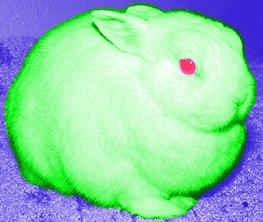 |
| Alba the Fluorescent Rabbit https://www.stretcher.org/images/sized/images/ uploads/features/bunny_1-263x222.jpg |
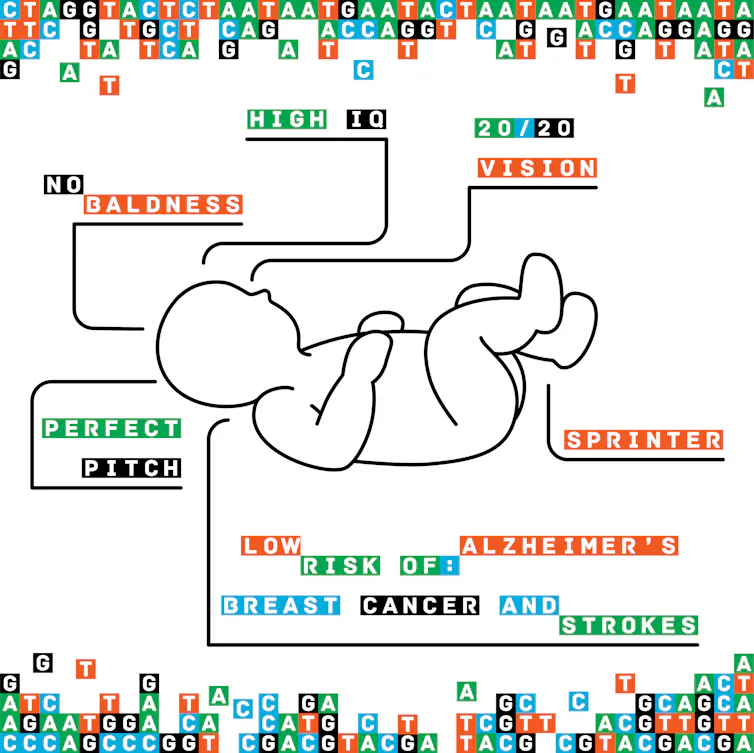 |
| Designing a Custom Baby https://images.theconversation.com/files/249303/original/file-20181206-128205-271ahs.jpg?ixlib=rb-1.1.0&q=45&auto=format&w=754&h=753&fit=crop&dpr=1 |
Sources
Kac, Eduardo. “RABBIT REMIX.” GFP BUNNY, www.ekac.org/gfpbunny.html#gfpbunnyanchor.
“Painting With Penicillin: Alexander Fleming's Germ Art.” Smithsonian.com, Smithsonian Institution, 11 July 2010, www.smithsonianmag.com/science-nature/painting-with-penicillin-alexander-flemings-germ-art-1761496/.
Venter, Craig. “Watch Me Unveil ‘Synthetic Life.’” TED, www.ted.com/talks/craig_venter_unveils_synthetic_life.
Vesna, Victoria, narr. “BioTech Art Lectures I-V.” N.p. web. 5 Nov 2012.
Yetisen, Ali K., et al. “Bioart.” Trends in Biotechnology, vol. 33, no. 12, 2015, pp. 724–734., doi:10.1016/j.tibtech.2015.09.011.
Kac, Eduardo. “RABBIT REMIX.” GFP BUNNY, www.ekac.org/gfpbunny.html#gfpbunnyanchor.
“Painting With Penicillin: Alexander Fleming's Germ Art.” Smithsonian.com, Smithsonian Institution, 11 July 2010, www.smithsonianmag.com/science-nature/painting-with-penicillin-alexander-flemings-germ-art-1761496/.
Venter, Craig. “Watch Me Unveil ‘Synthetic Life.’” TED, www.ted.com/talks/craig_venter_unveils_synthetic_life.
Vesna, Victoria, narr. “BioTech Art Lectures I-V.” N.p. web. 5 Nov 2012.
Yetisen, Ali K., et al. “Bioart.” Trends in Biotechnology, vol. 33, no. 12, 2015, pp. 724–734., doi:10.1016/j.tibtech.2015.09.011.


Comments
Post a Comment