Week 7: Neuroscience + Art
Every time we enjoy a work of art, a hidden multitude of chemical reactions and electric potentials within neurons govern our perception and understanding of that experience. Neuroscience and art have always been intricately intertwined, with the "father of neuroscience" Ramon y Cajal using his artistic skills to draw beautiful representations of the neurons he observed (Vesna).
The Surrealist movement, which he propelled into popularity, searched for ways to unlock the human mind by relating to the unconscious (Salvador Dali and Surrealism). Modern advances in neuroscience may allow for artistic movements that interact more directly with consciousness than the Surrealist movement could. Current research indicates that certain visual features, such as bright regions and flashing lights, instantly draw the viewer's attention (Zaidel). Additionally, anthropological research suggests that "symbolic representation", the creation of art, has linked features: for instance, we still find the early caveman drawings artistically beautiful despite the numerous ways in which culture and society have changed. One day, research like this may allow for art that is so captivating and enthralling it may enthrall the human brain in a nearly addictive manner.
Sources
Frazzetto, Giovanni, and Suzanne Anker. “Neuroculture.” Nature Reviews Neuroscience, vol. 10, no. 11, 2009, pp. 815–821., doi:10.1038/nrn2736.
Kalat, James W. Biological Psychology. CENGAGE, 2019.
“Salvador Dalí and Surrealism.” Salvador Dali Modern Art and Surrealism | The Dalí Universe, www.thedaliuniverse.com/en/salvador-dali.
Vesna, Victoria. “Conscious / Memory (Part 1).” Lecture. 16 Nov 2012. <http://www.youtube.com/watch?feature=player_embedded&v=DLVQIwOn7o8>
Zaidel, Dahlia W. “Art and Brain: Insights from Neuropsychology, Biology and Evolution.” Journal of Anatomy, vol. 216, no. 2, 2010, pp. 177–183., doi:10.1111/j.1469-7580.2009.01099.x.
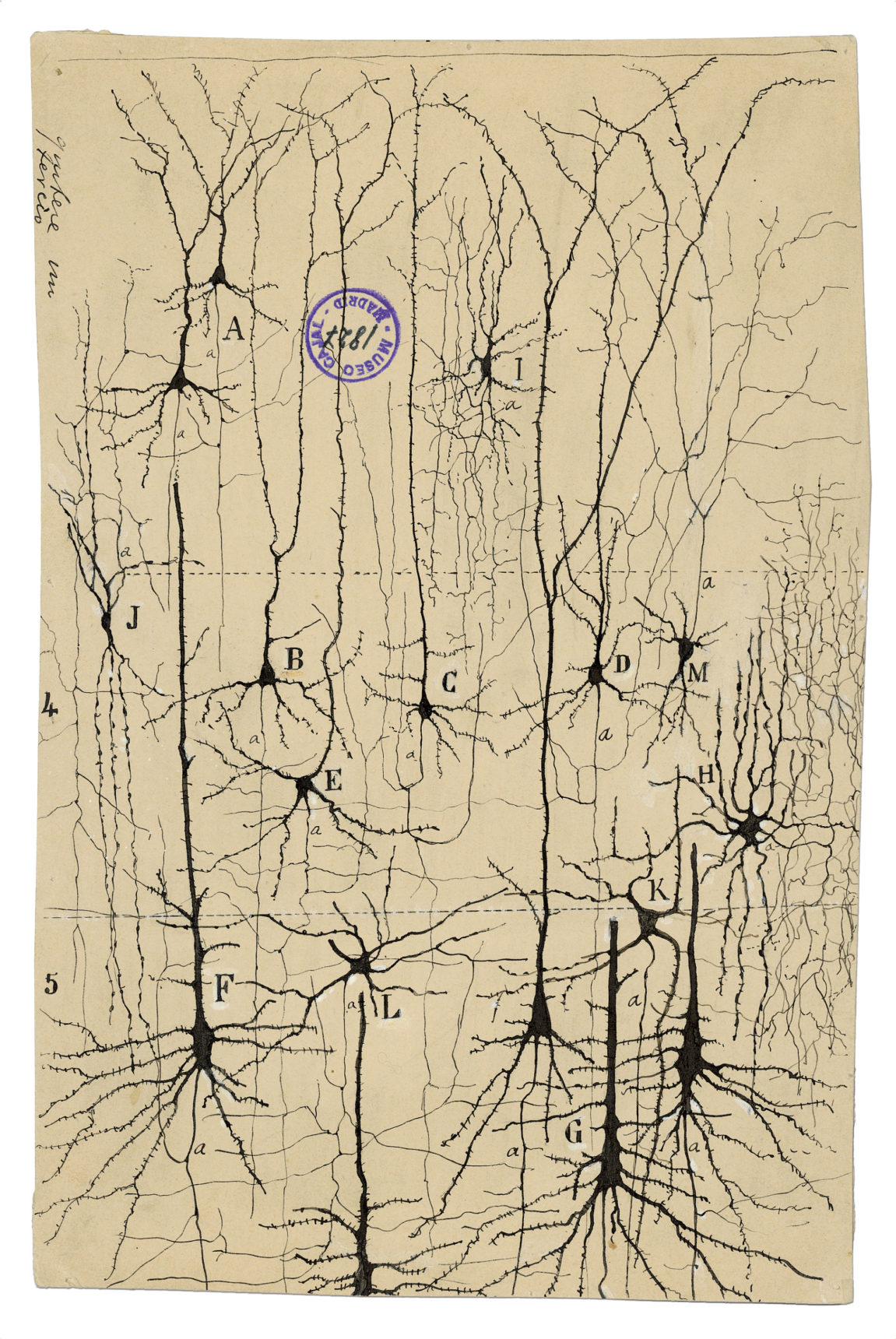 |
| Ramon y Cajal Sketch https://d2r55xnwy6nx47.cloudfront.net/ uploads/2017/09/Drawing_03-1151x1720.jpg |
It is strange to see how the populace...disdains the world around it as commonplace without suspecting that at bottom it is all secret, mystery, and marvel. - Ramon y Cajal (Kalat)In modern times, the public and artist's interest in neuroscience has increased dramatically, with research being done on the ways in which our brains respond to different visual cues in art (Frazzetto). In my opinion, Salvador Dali is one of the most influential artists who used an understanding of the human brain to create art that captivates the viewer. His careful use of illusion and perspective played with the viewer's perception, which is intricately tied with neurophysiology.
 |
| Old Couple or Musicians http://3.bp.blogspot.com/-3PAMOcssHkA/VmZGC-Vb5ZI/ AAAAAAAAAAw/loGAnj5fwqg/s1600/OLDCOUPLEDALI.jpg |
The Surrealist movement, which he propelled into popularity, searched for ways to unlock the human mind by relating to the unconscious (Salvador Dali and Surrealism). Modern advances in neuroscience may allow for artistic movements that interact more directly with consciousness than the Surrealist movement could. Current research indicates that certain visual features, such as bright regions and flashing lights, instantly draw the viewer's attention (Zaidel). Additionally, anthropological research suggests that "symbolic representation", the creation of art, has linked features: for instance, we still find the early caveman drawings artistically beautiful despite the numerous ways in which culture and society have changed. One day, research like this may allow for art that is so captivating and enthralling it may enthrall the human brain in a nearly addictive manner.
:max_bytes(150000):strip_icc()/full-frame-shot-of-handprints-on-rock-at-cueva-de-las-manos-691100153-5b6620fdc9e77c00501e8974.jpg) |
| Ancient Cave Art https://www.thoughtco.com/thmb/tSjQcEM8P3oePiuF-WEvmZCJu9M=/768x0/filters:no_upscale():max_bytes(150000):strip_icc()/full-frame-shot-of-handprints-on-rock-at-cueva-de-las-manos-691100153-5b6620fdc9e77c00501e8974.jpg |
Sources
Frazzetto, Giovanni, and Suzanne Anker. “Neuroculture.” Nature Reviews Neuroscience, vol. 10, no. 11, 2009, pp. 815–821., doi:10.1038/nrn2736.
Kalat, James W. Biological Psychology. CENGAGE, 2019.
“Salvador Dalí and Surrealism.” Salvador Dali Modern Art and Surrealism | The Dalí Universe, www.thedaliuniverse.com/en/salvador-dali.
Vesna, Victoria. “Conscious / Memory (Part 1).” Lecture. 16 Nov 2012. <http://www.youtube.com/watch?feature=player_embedded&v=DLVQIwOn7o8>
Zaidel, Dahlia W. “Art and Brain: Insights from Neuropsychology, Biology and Evolution.” Journal of Anatomy, vol. 216, no. 2, 2010, pp. 177–183., doi:10.1111/j.1469-7580.2009.01099.x.


Comments
Post a Comment